JUDY WOODRUFF: Next tonight, looking for the best way to feed India. The challenge has led to new questions about India's first successful drive to produce more food, known as the green revolution and created by American plant scientist Norman Borlaug, who died last weekend.
NewsHour correspondent Fred de Sam Lazaro reports from India.
FRED DE SAM LAZARO: By the middle of this century, India will overtake China to become the world's most populous nation. The question is, where will the food come from for 1.5 billion people? Already half the kids under age 4 in the country are malnourished.
Seventy percent of India's people are rural. They barely scrape by off tiny plots of land. Every year, tens of millions of them are driven by poverty into overcrowded cities in search of work. That means fewer and fewer food producers and more mouths to feed. At the same time, environmental degradation threatens the prosperous breadbasket region of Punjab.
Amitabha Sadanghi thinks one solution to the food crisis is to make small subsistence farmers more productive. He goes to villages like this one in the impoverished northern state of Uttar Pradesh and gets everyone's attention by inviting them to the movies.
These actually are very long commercials for products sold by his nonprofit enterprise, but they have all the movie staples, he says.
AMITABHA SADANGHI, International Development Enterprises, India (through translator): Bollywood style, with known actors and a good story. You have romance, fights, songs, dances, everything.
FRED DE SAM LAZARO: And at the end of the story, in true Bollywood style, everyone lives happily ever after, thanks either to the KB treadle pump or the KB drip irrigation system. More than a million farmers already have brought these products.
They are simple devices that provide farmers who now grow one rain-dependent crop each year the water to grow additional crops during the dry season. And there are other advantages, as well, according to Sadanghi, a social entrepreneur who believes there are market solutions to poverty.
AMITABHA SADANGHI (through translator): They go out of the village and take anything, rickshaw-pulling, roadwork. But after getting a treadle pump, they stay in the village in the house. They have two extra crops. They have an extra $500 a year they didn't have before. And another thing: When children go to the cities, they don't go to school. Here at least they do attend school.
Lessons lost from Green Revolution
M.S. SWAMINATHAN, plant geneticist: With more urbanization and the younger generation in towns and cities, they are not able to understand the importance of agriculture.
FRED DE SAM LAZARO: M.S. Swaminathan agrees it's important to keep small farmers in their villages, but he's best known as the plant geneticist who led a high-tech revolution that brought industrial-scale agriculture to India.
Half a century ago, Swaminathan worked with American Nobel laureate Norman Borlaug to introduce what then were new fast-growing hybrid crops and synthetic fertilizers and pesticides. Almost overnight, it made the plains of Punjab resemble the wheat fields of Kansas.
M.S. SWAMINATHAN: It was not an evolutionary change, but a revolutionary change. Evolutionary means 4 percent, 3 percent. Here it was 100 percent, 200 percent. So within four years, within 1964 to 1968, India produced from 10 million tons to 17 million tons of wheat.
FRED DE SAM LAZARO: For decades, Punjab has fed the nation with bumper harvests of wheat and rice, but now there are clear signs the green revolution has plateaued. Swaminathan saw early signs of problems.
M.S. SWAMINATHAN: But I noticed even at that time some of the farmers were starting applying too much fertilizer, and in the case of rice, too much pesticide, they were overexploiting the groundwater.
FRED DE SAM LAZARO: Farmers were encouraged to maximize production with free electricity and subsidies to buy water pumps, and they had no incentive to conserve water. That, too, was free.
Now the water table that fed the green revolution is declining alarmingly, says Baldev Singh Siddhu with Punjab Agricultural University.
BALDEV SINGH SIDDHU, scientist: At a rate of 75 centimeter per year.
FRED DE SAM LAZARO: That's two-and-a-half feet.
BALDEV SINGH SIDDHU: Yes.
FRED DE SAM LAZARO: Per year. And how long has that been happening?
BALDEV SINGH SIDDHU: It's happening around the last five to seven years.
FRED DE SAM LAZARO: At that rate, he says, rice and wheat production could collapse in 10 to 15 years in many parts of India's grain belt. To prevent that, Siddhu is part of a government effort to introduce conservation practices. They teach about tools like tensiometers that measure soil moisture, about planting schedules that can use more rain rather than groundwater.
Water isn't the only problem. As the soil deteriorates and pests become increasingly resistant, more and more expensive fertilizers and pesticides are needed to maintain the crop yield.
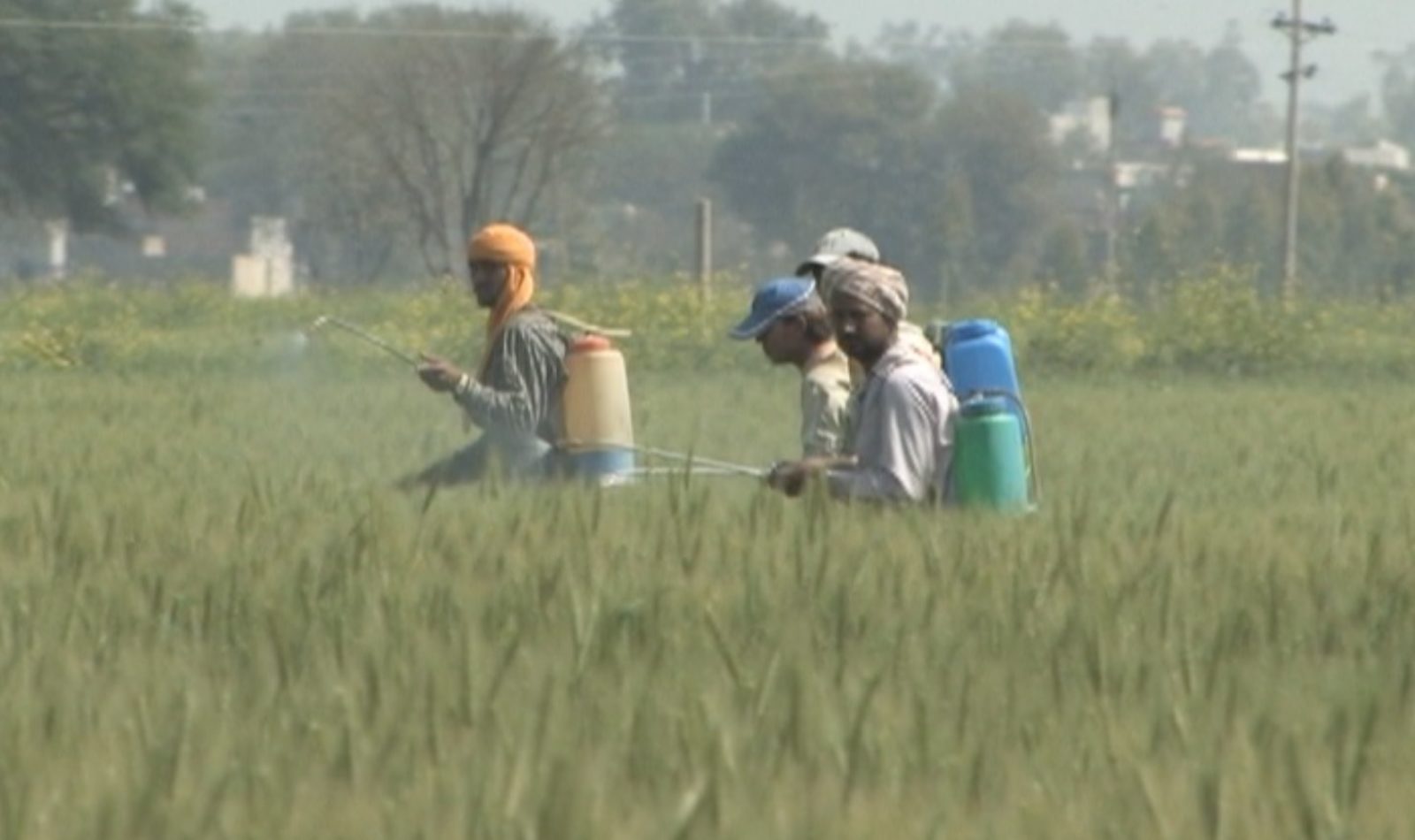
Karnal Singh was spraying pesticide on his wheat crop, and a lot of his exposed body, when we stopped to talk to him.
KARNAL SINGH, farmer (through translator): It's a green color pest, sucks out the grain inside, so that's why I spray this time every year when it becomes cloudy. That's when this pest appears, and that's why I'm spraying it.
FRED DE SAM LAZARO: And he wasn't worried about not wearing any protection.
TRANSLATOR: He's saying that it's not killing the pests, so it's not enough intoxicating to me, also.
FRED DE SAM LAZARO: So it's hardly killing the pests, so it can hardly hurt him?
TRANSLATOR: Yes.
FRED DE SAM LAZARO: Other farmers, like Karnail Singh, say chemical farming has become a necessary evil.
KARNAIL SINGH, farmer (through translator): This is an age of competitive farming. We have to use chemicals. I know it's bad for our health and for my family's health, but I have no choice.
Barriers to new farming methods
FRED DE SAM LAZARO: Dr. Swaminathan says what's needed now is a comprehensive approach, ecologically sustainable practices and new technology, perhaps including genetically modified seeds that are more immune to disease and drought. There are fears that climate change could add further stresses on farmers' fields here. And he says farmers will need some assurance of decent prices.
But, Swaminathan says, change is much harder today than in the 1960s when scientists, lawmakers and farmers worked in symphony.
M.S. SWAMINATHAN: Today, that symphony has been broken. Everybody has become -- there are so many ministries. As the bureaucracy has grown, the departments have proliferated. There's one for fertilizer, one for pesticide, one for water, one for food processing, one for agriculture, and one for rural development like this. Therefore, cohesion, cooperation, coordination has become at the governmental level itself, has become much more complex today.
FRED DE SAM LAZARO: For his part, Amitabha Sadanghi says India has put too much emphasis on large-scale modern farming. He says the majority of India's farmers don't live in the country's grain belt and have far more basic needs.
AMITABHA SADANGHI (through translator): The green revolution, with all their research and development, that's done nothing for these people. It's for Punjab, for the big farmers. All the research, even now, is for those people. This did a lot, but in India, 80 percent of the farmers are like the people you see here.
FRED DE SAM LAZARO: So those are the customers Sadanghi targets for drip irrigation systems in arid parts of India and treadle pumps in wetter regions. So far, his group, known as International Development Enterprises India, or IDEI, has sold 750,000 pumps, installed for just $50 each.
He's able to keep costs low through aid from international foundations. IDEI also earns revenue from groups that pay for carbon offsets, since its pumps require no more energy than the foot power of farmers like Rajarani. She farms about a third of an acre with her husband, Ramdhan.
RAJARANI RAMDHAN, Farmer (through translator): Before, we only grew wheat, but now we're able to grow vegetables, tomatoes, okra, gourds, so we're able to make profits from these.
FRED DE SAM LAZARO: Those profits allow both her children to attend school, but ironically her dream for her son is to join the urban exodus, to find a job as far away from the farm as possible.
JUDY WOODRUFF: Fred's report was part of a joint initiative of the Pulitzer Center on Crisis Reporting and the Project for Under-Told Stories at St. John's University in Minnesota. You can find links to their stories on our Web site, newshour.pbs.org.